Part 2
Circa 1971 to 1973
Please read Part 1 of this story to get full context.
A reader shared a couple of thoughtful comments regarding Part 1, which prompted me to add a bit more background related to those observations. Vern Gagne—who many remember as a hugely popular professional wrestler in the 1960s and ’70s—was, in fact, an accomplished amateur wrestler long before his pro career. He won two NCAA titles and was an alternate for the U.S. freestyle wrestling team at the 1948 Olympic Games.
Gagne had a promising future in both football and wrestling, but his career was interrupted in 1943 by a tour of duty with the United States Marine Corps. He later served with the U.S. Navy’s Underwater Demolition Team. After the war, he returned to the University of Minnesota, where he captured his two NCAA championships as an amateur wrestler. Like many veterans of his generation, he didn’t boast about his titles or his military service.
He was drafted by both the Chicago Bears and the Green Bay Packers, though his professional football career never extended beyond a few preseason games. Instead, he chose to focus on wrestling—the path that would ultimately define his legacy.
You may also remember Gagne as the spokesman for the vitamin supplement Gera-Speed, which sponsored the All-Star Wrestling television program in Omaha, Nebraska. The video featuring Gera-Speed’s creator, Joe Zweiback, is worth another look if you didn’t catch it while reading Part 1.
The same reader also asked me if I knew what the content of Gera-Speed was. The product is no longer made, as you might guess. After a bit of research, the best I could find was the information below. As it turns out, vitamins were not highly regulated back in the 70’s and it seems as though no records were kept. If you took Gerea-Speed, you are probably safe.
Likely vitamins
- Vitamin A
- Vitamin C
- Vitamin D
- Vitamin E
- B‑complex vitamins (B1, B2, B3, B6, B12)
- Folic acid
- Pantothenic acid
- Biotin
Likely minerals
- Iron
- Calcium
- Magnesium
- Zinc
- Copper
- Iodine
- Manganese
These were common in 1970s vitality tonics:
- Liver extract
- Brewer’s yeast
- Lecithin
- Royal jelly
- Ginseng
- Amino acids (lysine, methionine, etc.)
- Desiccated glandular extracts (common at the time)
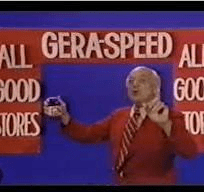
My cousin Tim remembered All-Star Wrestling. He said KETV at 27th & Douglas had a big auditorium where they televised these wrestling matches. One of his friends had a father, who was Officer Gibney of the Omaha Police. Officer Gibney was sometimes assigned to security at KETV to keep the rowdy fans from getting out of control. He would let the neighborhood boys sit up in the nosebleed section for free. Quite a thrill to see the famous wrestlers in person. He also sent me this YouTube link of Vern Gagne vs. Dr. X.
Anyway, on with Part 2: Even after my frustrating year of Wrestling when I was in 8th grade, I decided to try again when I was a freshman in high school. My classmates that also decided to wrestle were:
Rob Ulrich
Leonard Hickey- veteran
Tim Demanett (RiP)-veteran
Randy Hunt-veteran
Me-veteran
James Fetterer- Manager (RiP)-veteran
David Valentine- Manager (RiP)-veteran
The coach in the picture is Larry Palmer.
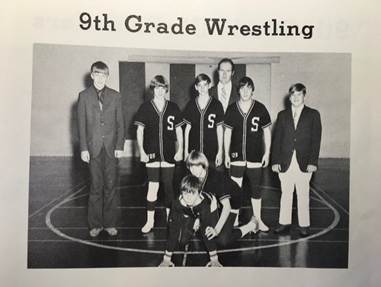
As a freshman, this would be the first year that Shenandoah High School had varsity wrestling. I figured with a new sport there had to be a spot for me.
I weighed about 122 pounds—skinny, but quick and reasonably strong. I had a real shot at making varsity that year. Imagine that: a freshman on varsity. I’d be cool. I’d be popular. It didn’t even matter how good I was. There was only one other wrestler in my weight class—Rod Howland (RiP), a senior at the time. He was my only competition, and I honestly believed I could beat him for the varsity spot.
But first things first—I had to get down to 112 pounds. Ten pounds to lose.
Back then, the weigh-in rules were downright archaic. If you wrestled at 112, you had to weigh in at 112 for every match until about mid or late season, when you might finally be allowed a couple of extra pounds. Think about that. High school kids—still growing, still developing—were expected to shrink themselves just to compete. That meant more than dieting. It meant sweating the weight off your body, any way you could.
During those years, my good friend Randy Hunt and I spent a lot of time together. Randy was also wrestling and wastrying to make 105 pounds. Most of our conversations revolved around food. We were growing boys who desperately needed nutrition, yet we dreamed endlessly of pizza, chips, pop—anything.
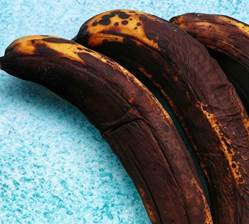
One day my mom asked, “Who ate all the ripe bananas? I had three of them for banana nut bread! Who ate them?”
In my mind, ripe meant rotten.
Randy was at my house that day, and he was so hungry he ate those black, mushy bananas. We were in dire straits—like the Donner Party—but even then, I would never have attempted that. That was some truly bad stuff.
Hunger does strange things to the mind.
Another way we tried to lose weight was by wearing plastic exercise tops and pants, basically sweating the water right out of our bodies. We’d crank the showers full blast in the locker room, turn the heat up, and run in place, do jumping jacks—anything to drop a few pounds. It was insane. We even ran the halls of the high school. There was a rumor going around that if you didn’t swallow your own saliva, you’d lose more weight. So, as we ran, we spit everywhere—hallways, lockers, classroom doors, the floor. We were absolutely disgusting.
Our opening varsity match was coming up. We were set to wrestle Sidney, Iowa—a small town about a third the size of Shenandoah. The anticipation was high because both schools had started varsity wrestling the same year. That alone fueled a rivalry that would last for years. And for a small town, Sidney had some tough wrestlers. Farm boys who worked all summer, building real strength, and who weren’t intimidated by anyone. This was going to be exciting.
If there was more than one wrestler in a weight class, you had to have a “wrestle-off” to earn the varsity spot. After weeks of practice, I knew I could beat Rod. I dominated him every day—taking him down, breaking him down, escaping easily from the bottom. It was a lock.
Wednesday came. The meet with Sidney was Friday, and wrestle-offs were that day. Coach Mosley was the referee. Rod and I met in the center of the mat, shook hands, and the whistle blew. I took him down immediately—two points. I was in control. This was it. I was going to be varsity.
Who was I going to start dating?
I could have any girl I wanted.
I mean, shit—I was varsity.
For the next four minutes it was nothing but a grind. I was on top, riding him most of the time—stalemate after stalemate. With about a minute left, he finally escaped. The score was 2–1. We were both back on our feet.
Takedowns were my strength. I owned him there. All I had to do was stall for another minute—or better yet, score one more takedown and seal it. Varsity. The girls would love me. I’d be an idol. I was way too confident.
We drifted toward the edge of the mat, and I expected Mosley to blow the whistle and send us back to the center. I paused, waiting. I relaxed. That’s when Rod saw his opening and shot in on my legs. A clean double-leg takedown. Two points.
I lost.
I was crushed. Varsity wasn’t happening. I was stuck with Junior Varsity.
The night of the meet against Sidney, I wrestled JV. My opponent was a guy named Erskin Kaulkis. I don’t know why I remember his name, but I do. I pinned him in about fifteen seconds—and bragged about it for the next week. Sidney’s varsity team beat Shenandoah that night and kept doing so for several years afterward.
By then, I had decided I was done killing myself to make 112 pounds. I intentionally moved up to 119. Honestly, I didn’t care about making weight anymore. At one JV meet, I didn’t make weight at all and assumed that meant I wouldn’t be wrestling. Fine by me. I still had to show up to support the team, but as far as I was concerned, my night was over.
I went home after school and crushed two Schwan’s hamburgers and a pile of chips. Remember Schwan’s? Best food—and ice cream—ever. Delivered right to your door. Man, I loved that.

When I got back to the school to watch the meet, Coach Palmer—the assistant coach—cornered me in the locker room and told me I’d be wrestling up two weight classes that night. They needed a body. A match was already lined up. It was JV, so who really cared if it was a complete mismatch?
I told him I couldn’t wrestle. I’d just eaten two hamburgers.
He completely lost it. Absolutely lost his mind. He punched a locker door so hard his fist went straight through the metal. I’m not exaggerating. Right then and there, I decided—again—that I hated this sport.
The rest of the season was pretty uneventful as far as my “career” was concerned. I probably won a few JV matches, but I’m guessing I spent most of my time flat on my back. At practice since I was now at 119 pounds, I had to wrestle Bruce Foster and Larry Franzen—both juniors and, without question, two of the grossest human beings on the planet. They never washed their practice gear. Ever. They smelled like something that had crawled out of a swamp and died there.
Truth be told, I beat Foster most of the time. He was a wimp. Franzen wasn’t very strong, but he had decent technique and usually beat me. I didn’t care. He smelled so bad that I was happy to let him pin me just to get away from him.
This was a disgusting sport, but for some reason I tried again my sophomore year.
By this time, I had grown a bit more and was wrestling at either 138 or 145 pounds. There was never any realistic chance of me making varsity. My main competition was Jim Hunt a senior (RIP—a veteran who later earned the Silver Star in the first Iraq War) and, I believe, Jerry Hilton (RIP).
Jim was a very good wrestler—strong and quick—but he smoked far too many Marlboros, which probably kept him from ever reaching his full potential, not just in wrestling but in other sports as well. Jerry had an unusual condition that caused him to hyperventilate. When it happened, he would begin rapid, deep breathing—over breathing, really—which I later learned could reduce carbon dioxide levels in the blood. At the time, it looked to me like he was having a seizure.
When Jerry went into one of these episodes, his teammates would have to hold him down, and as I recall, someone would place a bag over his face so he could rebreathe exhaled air. By today’s standards, it was a lawsuit waiting to happen—no doctor, no medical professional—just a coach or fellow wrestler holding a bag over his nose and mouth.
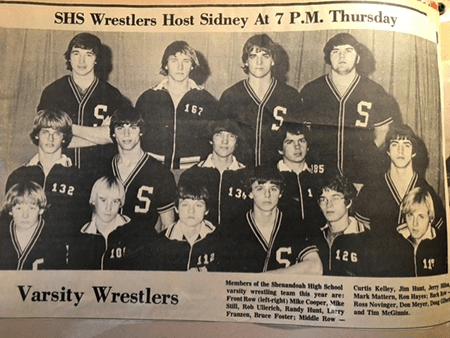
Below is a clipping from the local newspaper, the Evening Sentinel, showing the varsity wrestling team during my sophomore year. My good friend Mike Cooper (bottom left) wrestled at 98 pounds, and for a first-year wrestler, he did very well. Mike would go onto have a pretty good career. Randy Hunt was on varsity at 119 and also had a solid season and career. In the top right is Tim McGinnis, one of the best wrestlers Shenandoah ever produced—I believe he placed third in the state that year. All in all, it was a fairly well-rounded team.
Below is another picture of Randy Hunt just finishing a match. I am not sure what meet this was but he was a good wrestler like his brother….he also could have been better if he had stayed away from Marlboroughs. Randy was a bit slow, but a very patient and meticulous wrestler.
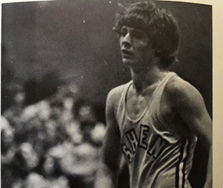
If you read Part 1 of “The Wrestler”, you might note that Tim Demanett is surprisingly not on the varsity team. I think he wrestled at 145 and believe it or not by this time I was beating him in practice. I had finally caught up with him from a physical maturity perspective. I think this might have been Tim’s last year wrestling as well. I know he did not wrestle as a senior and I don’t remember him wrestling as a junior either. I am betting he got a bit frustrated, no longer being the big dog.
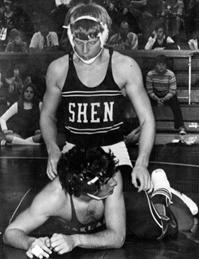
I had some success on the JV squad my sophomore year. During one match that I won, my parents had paid a photographer to take some pictures of me wrestling. I had no idea. I dominated this dude from Oakland and you can see below that he is looking at the clock wanting to get this over with. Timing is everything and I am thankful I won this match!
That year, I did get one brief shot at fame.
Jim Hunt was expelled from school for a couple of days for cussing in Mrs. Rhodes English Literature class. I don’t remember exactly what he said, but back then there was zero tolerance for that sort of thing. As a result, I got the call-up to varsity. We were scheduled to wrestle Glenwood High School—a program with a long history and a very strong team. They’d been around for years and had sent plenty of wrestlers to the state tournament.
I remember sitting in a small conference room in the school library, trying to study, when Coach Mosley (RiP) walked in. He told me Jim was suspended and I would be taking his spot. My heart immediately started racing. I couldn’t concentrate for the rest of the day. I knew our team had a real chance to beat Glenwood that year—and I also knew exactly who I would be wrestling: Kevin Crouch. He was one of the better wrestlers in southwest Iowa and had previously competed at the state tournament.
The anxiety was overwhelming. Even now, I can still remember my heart pounding in my chest. It was up to me to help the team beat Glenwood.
It felt like it took forever for the meet to start. Before the matches, all the wrestlers were introduced. I got to wear a varsity uniform and sit with the varsity team. When my name was called, I ran to the center of the mat and shook hands with my opponent. I could hear my friends cheering and yelling encouragement. The Shenandoah gym was packed, the place buzzing with excitement. My heart was pounding. All I wanted to do was stay off my back—just don’t get pinned.
Finally, it was time. The team score was pretty close. Every match mattered. We met in the center of the mat, shook hands again, then the referee blew the whistle, and we were off. We locked up, and I could immediately feel his strength. He made several quick shots at my legs, but I managed to counter them. At the end of the first period, the score was 0–0.
In the second period, I chose the top position. My job was simple: ride him and keep him from scoring for two minutes. I held my own for a while, but eventually he escaped and scored one point. We locked up again and battled for a takedown. I lunged for his leg, grabbed it, and pulled it in tight. Somehow, I managed to get behind him. Takedown—two points for me. At the end of the second period, the score was 2–1 in my favor. I was gaining confidence.
The third period started with me in the down position. I just had to survive two minutes. I could win—or at least avoid the nightmare of being pinned. For what felt like an eternity, he tried to break me down. I was pretty strong and managed to counter every attempt. I glanced at the clock: 45 seconds left.
Then the referee warned me for stalling. I had to move.
I went for a reversal. I’m still not exactly sure what happened next. I think the reversal worked, but I got too high over him, and he immediately reached around my head and rolled me onto my back. Before I fully realized what was happening, the referee blew the whistle. I was pinned. The Glennwood crowd roared.
I lost.
I felt like I had let the team down. I felt like shit.
Coach Mosley was incredibly gracious—comforting, even. He knew I had given everything I had. I don’t think he truly expected me to win, and my teammates were supportive as well. Still, I was my own worst enemy. I was merciless with myself. If I hadn’t gotten pinned, we probably would have won the meet.
All I could think about was how badly I had blown it.
I hated getting my ass kicked in front of my friends and family. By then, I just wanted the season to end. I won a few more matches, lost a few more, and tried to convince myself it didn’t matter. But it did. Wrestling had become more frustration than joy.
When the season ended, Coach Mosley announced he was moving on to another opportunity. I really liked him—down to earth, fair, but firm when he needed to be. Losing him felt like the final sign that it was time to walk away.
So, my junior year, I lifted weights during wrestling season and focused on football, a sport I was reasonably good at. Every now and then, I wonder what might have happened if I’d stayed with wrestling—if a little more patience, a lot more confidence, might have changed the outcome. Of course, I’ll never know.
Mike Cooper and Randy went on to have successful careers. I watched from a distance, carrying the quiet knowledge that some paths, once left behind, don’t circle back—but they still linger, asking questions long after the answers no longer matter.

 My View from 1958
Leave a comment