Final Chapter
First, Some “Humble Pie”
When we travel I-80 across Iowa, we’ve passed the Brooklyn, Iowa exit dozens of times. At that spot there’s another sign that reads, “Home of Harold ‘Pie’ Keller.” On a trip this past week, curiosity finally got the best of me, so I Googled Harold Pie Keller. I assumed he must have been a hometown sports hero or some local celebrity… but I couldn’t have been more wrong.
Harold grew up in rural Brooklyn, Iowa, a town of about 1,500 people. Born in 1921, he joined the Marines during WWII, just as so many young men of his generation did. He fought in some of the toughest battles of the Pacific—Guadalcanal, Bougainville, and Iwo Jima. During the battle of Iwo Jima, he was part of the patrol that reached the top of Mount Suribachi in 1945 and raised the American flag—a moment captured in the iconic photograph that inspired the Marine Corps War Memorial in Washington, D.C.
What’s remarkable is that when Harold returned home, he never talked about it. No one knew he was one of the flag raisers until 2019, when the Marine Corps announced the correction after investigating decades of misidentified men in the photograph.
Keller died in 1979, nearly twenty years before receiving recognition. Like so many from the Greatest Generation, he left home to fight for freedom and came back to live a quiet, humble life—never bragging, never telling war stories. And the nickname “Pie”? That came from eating too much pie before a high school football game and getting sick on the field.
There’s a memorial to him in Brooklyn, and on my next trip I’ll definitely stop to see it. A truly American story—and a reminder of the greatness of that generation.
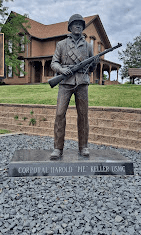
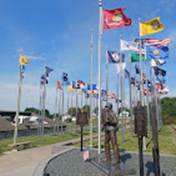
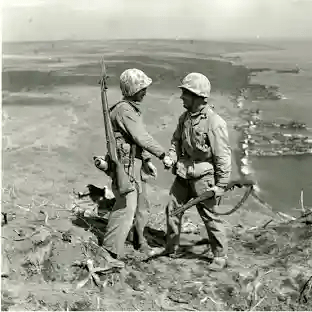
A picture of “Pie” on Iwa Jima (on the left)
Now, back to The Route!
Once a week I had to collect money from my newspaper customers. I think the paper cost 25 cents a week back then, and I still remember some folks practically revolting when the price went up to 30 cents. I’d start collecting on Thursday evenings after my route, usually around 6:00 p.m. I went door to door, rang the bell or knocked, and waited. When someone answered, I’d say, “May I collect?” Most people cheerfully handed over their change, but a few liked to tease me with lines like, “Oh, I suppose,” or “What if I don’t want to pay?”
For some reason, one of the clearest memories I have of those nights is the smell of each house. When the door opened, the scents would rush out like heat from a blast furnace—dinner cooking, cigarette smoke, perfume, liquor, sweat, or just the stale air of a closed-up home. Every doorway had its own signature smell.
Collecting typically took about three hours, so I was usually home by nine. No one worried about a kid being out after dark with a pocket full of money. It was small-town America in the late ’60s and early ’70s. What bothered me most wasn’t safety—it was missing my favorite Thursday night TV shows like Batman, The Man from U.N.C.L.E., or Red Skelton.
Once I’d finished, I’d rush to my room, empty my pockets, and count the haul. I wanted to know if I’d made a profit. First, I had to pay for the papers out of what I collected; whatever was left was mine. I usually made a little money—but I was always dreaming of big bucks. And Saturday was right around the corner!
My next stop came on Saturday morning. I’d hop on my bike—and sometimes just walk—over to the Evening Sentinel office to pay my bill. The Sentinel sat in an old brick building in downtown Shenandoah, where the smell of ink and grease seemed baked into the walls. All of us paper carriers would line up to hand over our collections to a man named Jack Funk. Jack would slowly and meticulously count every dollar, making sure we weren’t even a penny short. If he found a mistake, he’d start the whole process over again. It felt like it took ages. He kept an old rusted box for the money, and to me he seemed impossibly old. Turns out he actually was; born in 1893, a veteran of the First World War, quietly keeping order in that little corner of the newspaper world.
Once I paid the bill, I’d head straight to Woolworths to spend my hard-earned money. Woolworths felt magical back then—they had Hot Wheels, plastic army men, goldfish and chameleons (yes I actually brought them both home to mom’s surprise), Tonka trucks, toy ships and airplanes, toy guns, G.I. Joes, Johnny West figures, and, best of all, Matchbox cars. I bought plenty of toys and accessories over the years, but nothing topped those 50-cent Matchbox cars and trucks. I used to build entire worlds with them—construction sites, roads, airports, cities, even superhighways. I’m pretty sure I had at least 150 at one point, though they’ve all vanished over the years. No matter—I’ve started collecting them again.
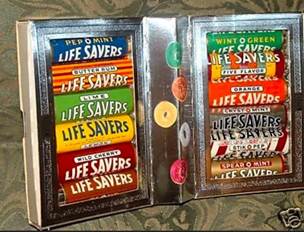
I have especially fond memories of collecting paper route money in the weeks leading up to Christmas. People always seemed a little kinder that time of year and would often invite me inside to warm up for a moment. This was December in Iowa, after all—and it sure felt like we had more snow back then. I never wore gloves because I had to count change, so my hands were always freezing. Customers were generous, too. Some would give me a two- or five-dollar tip, or slip me treats like chocolate-covered cherries, Life Savers holiday packs, cookies, candy canes, or peanut brittle.
I loved walking my route in the stillness of the evening, especially in the fresh snow. It made a crisp crunch—or sometimes even a little squeak—with each step. Almost every house had Christmas lights or decorations: Frosty, Santa Claus, sleds, toy soldiers, and giant candy canes. Colored lights traced rooflines and gutters. It was magical, the way the lights glowed and reflected off the snow.
JCPenney, Montgomery Ward, and Sears all delivered their Christmas catalogs around this time of year, too. Oh man, there was nothing better than flipping through those pages and looking at all the toys—you probably loved that as much as I did. And of course, all the classic Christmas shows were on TV: Frosty the Snowman, Rudolph the Red-Nosed Reindeer, A Charlie Brown Christmas. I know you watched those. Then came the big TV Christmas specials—Bob Hope’s USO show, Andy Williams, Dean Martin, and the Glen Campbell Christmas specials. It was all part of the season.
What a wonderful time. I am so blessed to have grown up in small town America during the 60s and 70’s. These were good days.


 My View from 1958
Leave a reply to Tim Vermillion Cancel reply