I decided to try something different with this series of posts. Instead of writing about my own adventures growing up in a small town, I’ve begun creating a short historical fiction story. I’ve always loved history—especially the history of the American western frontier from the 1820s through the 1880s.
This story follows a young man who joins the frontier army and finds himself stationed at a remote outpost in western Nebraska. I’m working to keep as many of the historical details accurate as possible, from the forts and frontier towns to the daily hardships faced by soldiers on the plains. The result is a blend of fiction and real history, bringing to life the sights, sounds, and struggles of the American frontier. I hope you enjoy the journey.
Date: March,1866
Fort Mitchell, Nebraska
Location: Western Nebraska, near present day Scottsbluff, NE. 120 miles northwest of Julesburg, Colorado.
The wind started before sunrise, as it always seemed to do out on the Platte. Some men swore it never stopped—only shifted direction.
“I hate the wind,” Private Porter thought. I hate that constant damn wind. Blow, you son of a bitch—blow! The words slipped out before he could stop them.
Dust scraped across the roof overhead, pushed through every crack in the adobe walls. Sudden gusts struck the fort hard enough to rattle shutters and doors. Around the corners of the buildings, the wind made a low, hollow whistle that never quite faded. It filled the ears, pressed against the skull, and wore on a man like hunger.
Porter stopped himself. What would my mother say about that language? She was a strict Methodist. He was raised a Methodist. He knew better. His mother taught him to read and write. She made him read the bible every evening and ensured he was in church every Sunday for the 3 hours of “fire and brimstone”. Dad was rarely in church claiming he had heard it all before, but his mom’s words still echoed in his head. “You’ll not use such language under my roof. Your mother and the good Lord gave you better words than that.”
Private Uriah Porter, Company H, 11th Ohio Cavalry, woke stiff and cold between two wool blankets inside the enlisted barracks at Fort Mitchell, Nebraska Territory. The post sat on the upper Platte River Road near Scotts Bluff, a small Army station built to support and protect travel along the Overland Trail corridor.
Dust had worked its way through the structure all night, settling into boots, rifles stacked by the wall, tin cups, and bedrolls. Out here, on the high plains, there was no escaping it. A man never really got clean.
He hated the dust. He hated the wind. He hated the smell of the crowded barracks. He hated the insects that came with the heat and refuse. He hated the Army, or at least the version of it he knew out here on the frontier.
Most of all, he hated being filthy. His hair was matted and greasy—lice were common in field posts like this. He felt them. He could smell himself, especially his feet. Mom would’ve had me in the creek with a bar of her lye soap before sunrise, he thought. Winter or not.
Outside, the pale light of dawn spread across the plains behind the dark silhouette of Scotts Bluff. Somewhere beyond the stockade fence, a mule brayed. A hammer rang out from the blacksmith shop, steady and familiar.
Then came the bugle.
Reveille.
Time to rise, or risk the attention of Sergeant Cooper.
Cooper was a career noncommissioned officer—likely British-born, as his accent suggested—one of the long-service Regular Army sergeants who had stayed in uniform through the expansion westward. His face was weathered and pocked, his beard untrimmed. Years of service had left him red-faced, rough-voiced, and hard to read. Alcohol was common among enlisted men and NCOs in remote posts, and Cooper was no exception.
He spoke with a thick Scottish brogue that often blurred his orders into something the men simply learned to interpret by tone more than words. What mattered was not clarity—it was volume.
When Cooper bellowed, men moved.
Private Uriah Porter didn’t know exactly how dangerous the sergeant was. He had no desire to find out. Cooper drank heavily, but he also knew soldiering—twenty-plus years in the Regular Army had made him efficient when it counted. Rumor placed him in the Civil War eastern campaigns, possibly Antietam or Gettysburg, though men on the frontier often traded stories that grew larger with distance.
Whatever his past, Cooper was not someone to test.
Once you got past the whiskey breath and tobacco stink, he was probably competent enough. Good enough to get me home in one piece, Porter thought. Stay out of his way when he’s drinking—which was most of the time.
He had seen what happened when men pushed him.
A private named Waterman—lazy, mouthy, always trying to avoid detail—had ignored repeated orders. Other soldiers complained that Cooper never enforced discipline.
Then, without warning, Cooper struck him once. Hard.
Waterman went down and didn’t get up immediately. For a moment, the barracks went silent. Men thought he might be dead.
“Pull your weight, soldier,” Cooper said. “Or you’ll get another.”
Waterman never caused trouble again.
Uriah learned the lesson too. Keep your head down. Keep your mouth shut. Do what you are told.
Around him, men rolled out of bunks, pulling on trousers, wool shirts, and fatigue blouses. Within minutes, the company street filled with soldiers stamping life back into numb feet and tightening cartridge belts. Smoke from the cook fire drifted across the yard.
Breakfast would soon be issued from the company cook: salt pork, hardtack, and coffee boiled strong enough to strip paint.
“Same old ration,” Uriah thought.
Salt pork was standard Army issue on the frontier—brine-cured pork packed in barrels to preserve it without refrigeration. It was durable, but often greasy and heavily salted. Hardtack, the staple bread ration of the Regular Army, was a simple flour-and-water biscuit baked until nearly rock-hard. Soldiers called it “sheet iron” or “tooth dullers,” and it often carried weevils by the time it reached remote posts.
Still, it was food.
Uriah thought again of his mother’s cooking—fresh biscuits, bacon, flapjacks, coffee from a real kitchen stove. Back home in Ohio, meals had been predictable, but warm and steady. Out here, breakfast was the only guaranteed meal issued by the Army. Dinner and supper were on the soldier himself. A man cooked, traded, or went without.
Most men did not complain. They had eaten worse. Uriah had eaten better—and still wondered why he left the family farm.
He knew the answer. The farm had eighty acres of repetition: planting, harvest, repair, repeat. No movement beyond the township, no horizon beyond the next season. He had wanted something else.
Adventure, he had called it.
He was still waiting for it to arrive.
When Uriah told his father, Reuben, he was going to join the Army he seemed indifferent, perhaps distracted. There were still 5 other boys to do farm chores and two girls to do the women’s work for the family. Maybe it was just the thought of one less mouth to feed. Reuben seemed tired by years of broken dreams and endless struggles. Susannah, Uriah’s mother, just walked away when he dropped the news. Not a sound. Uriah knew he hurt her, but he just had to get away.
The Porter farm was near the village of Batavia, Ohio. Batavia was platted in 1814 and named after Batavia, New York, continuing a pattern of settlers bringing familiar place names westward. It became the county seat in 1824. Uriah traveled from Batavia about twenty miles to Camp Dennison, Ohio to enlist and strike out on his adventure.
Private pay was thirteen dollars a month for an enlisted cavalryman, with deductions for clothing and equipment replacing worn gear. Uriah saved most of it and sent what he could home to his parents. Spending money near the post was dangerous—whiskey was plentiful, gambling was constant, and prostitution camps and river towns along the Platte corridor offered distractions men called “frontier life.”
He kept away from most of it. Tobacco, small repairs, and the occasional purchase from nearby civilian ranches or farms were enough.
It was an existence—but not the romantic one he had imagined when he enlisted.
Fort Mitchell itself was small and utilitarian: a stockaded post of adobe and timber buildings, with a parade ground, stables, and corrals for Army horses and mules. It was not a large permanent fort like those farther east; rather, it functioned as a supply and protection station along the Overland Stage and telegraph routes on the Platte River Road.
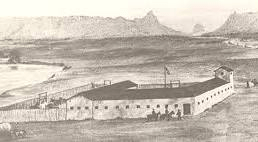
Actual Drawing of Fort Mitchell by William H. Jackson, 1866
Beyond its walls stretched open country—shortgrass prairie, sandy draws, and wagon ruts carved into the land by thousands of emigrant wagons moving west. Mitchell Pass through Scotts Bluff provided one of the most important natural corridors through the bluffs along the Oregon and California Trail routes.
The Army presence there was tied to a specific purpose: to protect emigrants, freight operations, telegraph lines, and stage routes during the Civil War era, when regular troops were stretched thin and many frontier posts relied heavily on small detachments of cavalry and infantry scattered across the Plains.
Time to get read for roll call and parade. Don’t be late or there will be hell to pay.
 My View from 1958
Leave a comment