You might recall a while back I had a short entry in my blog regarding an exit sign along Interstate 80 in Iowa that read, Home of Harold “Pie” Keller near the exit sign to Brooklyn, Iowa. Well as we continue to travel across Interstate 80 to visit friends and family, another exit sign at exit 201 caught my attention. This one was for the town of “What Cheer” which I thought was an unusual name. Here is a little background thanks to some internet research.
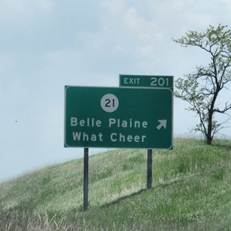
What Cheer, Iowa, owes its unusual name to an old English greeting meaning “Greetings!” or “How are you?” The town was originally named Petersburg when it was founded in 1865, but in 1879 the U.S. Post Office rejected the name because it was already in use elsewhere. A new name was needed, and local merchant and politician Joseph Andrews suggested “What Cheer.”
Andrews had roots in Providence, Rhode Island, where the phrase “What Cheer” holds historical significance. According to local tradition, when English settler Roger Williams arrived in the area in 1636, he was welcomed by Narragansett Native Americans with the greeting “What Cheer, Netop,” which roughly translates to “What cheer, friend!”
Another popular local legend offers a different explanation. It claims that a Scottish coal miner, excited after discovering a rich coal seam near the town, shouted “What cheer!” in celebration, and the phrase eventually became associated with the community.
Whatever its true origin, the name has remained one of the most distinctive in Iowa. If you ever visit, remember the local pronunciation: “Wa-Cheer,” with the “t” and “h” left silent. As far as notables are concerned, B. J. Palmer, the developer of chiropractic was born in What Cheer in 1882.
And finally, this may be my last chapter of “The Fort.” I would really like to hear from some of the thousands of my followers if they want me to continue this historical fiction story. Please let me know! For now, on with the story.
The work party moved slowly across the plains in creaking wagons pulled by mules. Dust followed them everywhere. The wheels groaned over dry ruts while leather harnesses squeaked with every step. The wagons carried axes, a crosscut saw, ropes, canteens, and enough bad humor to fill a barracks room. The weather was fine for late March….rather warm in fact. Not a cloud in the sky. And even more unusual, the wind was not blowing.
The party included three new recruits riding in the wagons. The recruits tried their best to look unconcerned, but Uriah could see the nervousness plainly enough. One young trooper checked the loading gate on his carbine so many times that Uriah finally told him the weapon would not improve from being inspected every five minutes. Another talked almost nonstop, filling the prairie air with stories and questions that nobody bothered answering.
Uriah recognized the signs.
The boys were scared.
Not terrified, perhaps, but uneasy in the way all green soldiers were when venturing beyond the protection of the fort for the first time. The open country had a way of making a man feel small. The endless grasslands, the distant bluffs, and the knowledge that help would be hours away weighed heavily on inexperienced minds. Worst of all, these recruits had little training.
Basic training in 1866 was nothing like modern military boot camp. There was no standardized training program, no obstacle courses, no drill sergeants in the modern sense, and little classroom instruction.
In fact, many frontier recruits (aka shavetails) received only a few weeks of training before being sent to a frontier post. They would receive a cursory physical examination, first issue of clothing, an enlistment contract and travel orders. The Army was trying to save money since the conclusion of the war, so each recruit only fired a few rounds from their rifles. Most recruits did not know how to ride a horse and were ill-prepared when they reached their assignments. The shavetails might be taught close order drills, the manual of arms and fundamental military protocol. The recruits received most of their military training on the job, which was a dangerous model. Sometime men were sent to battle before they were prepared. This lack of training is one reason that the Indian Wars dragged out as long as they did. It was not until the late 1870’s that the army initiated formal training for recruits.
These raw recruits made Corporal Scott a bit uneasy. He knew the chaos of battle. He knew that every man had to had to be depended on to do his duty.
Uriah remembered feeling scared on his first trip outside the walls. He was lucky he knew how to ride and shoot, yet outside the protection of the fort still put him on edge.
Corporal Scott led the party. Uriah rode alongside James; each man armed with a carbine and revolver despite the seemingly routine nature of the assignment. The cottonwood groves along the North Platte offered some of the best timber near the fort, but they also provided cover. Every soldier on the frontier knew that danger rarely announced itself. A rider appearing on a distant ridge, a flash of movement in the trees, or a horse found missing could be the first sign of trouble.
The joking that usually accompanied work details faded as they moved farther from the fort. The adobe walls behind them grew smaller with every moment until they blended into the landscape. Out here, they were on their own.
James shifted in his saddle and scanned the bluffs overlooking the river.
“Never cared much for these trees,” he muttered around his pipe. “Too many places for somebody to hide.”
Before anyone could answer, he drew on the pipe and immediately doubled over coughing. The fit was so violent that his horse flicked its ears back in annoyance. Uriah was a bit annoyed himself. He was glad he did not have to bunk near James.
“One of these days,” Uriah said, “that pipe’s going to kill you.” Uriah noted blood spats on his Jame’s chin.
James wiped his eyes and spat phlegm into the dust. He then wiped his chin with his shirt sleeve.
“Been trying for years.”
Even Uriah laughed at that.
By midmorning they reached a large, untouched cottonwood grove along the North Platte River. Uriah was amazed at how many trees had actually been cut down since he was at the fort. The party had to travel further and further away from the fort to get to wood.
The North Platte spread across the valley below like a sheet of broken glass. Instead of a single river, it seemed to be a dozen smaller rivers wandering among sandbars and islands of pale cottonwood. The water ran shallow in most places, glittering beneath the sun as it wound through the broad sandy bottom.
Uriah understood why travelers followed the Platte westward. In a country of endless grass and scarce water, the river was life itself. It provided water for men and animals, wood for cooking fires, and a natural road through the vast emptiness of the plains.
The trees rustled softly in the breeze while the river slid past beyond the brush. It seemed peaceful enough, but nobody relaxed. Uriah and James were posted as lookouts while the others began working. Corporal Scott managed the work detail, ensuring the load in the wagons was balanced, the mules were cared for, and a keen eye was always on the lookout. Axes bit into wood with dull thuds. The crosscut saw rasped back and forth through a fallen trunk.
Every few minutes someone paused and looked up.
The only sounds were the wind, the river, and the steady rhythm of chopping.
Still, Uriah felt the familiar uneasiness that came whenever he left the safety of the fort. The prairie seemed too large. Every draw, ravine, and patch of brush looked capable of hiding unseen eyes. Stories of ambushed patrols, stolen horses, and wagon trains attacked without warning had a way of staying with a man.
The smell of fresh-cut wood mixed with sweat, damp earth, horse manure, and tobacco smoke. By midday the men were filthy with dust, bark, and sweat. Hands blistered quickly, especially among the new recruits unused to frontier labor. Many soldiers had enlisted expecting adventure and cavalry charges, not endless chopping and hauling like farmhands.
At one point Uriah stiffened and pointed toward a distant ridge.
All work stopped.
Several soldiers reached for their carbines.
A dark figure stood silhouetted against the skyline.
For a long moment nobody spoke.
Then the figure moved.
Corporal Scott squinted.
“That’s a buffalo.”
The tension broke immediately.
A few nervous laughs followed.
“Good thing you’re not on lookout duty,” Eli said.
Uriah grinned.
“Wasn’t worried.”
“You were halfway to drawing that revolver.”
“Just being prepared.”
The men returned to work, but the interruption served as a reminder. Even so, the men never truly relaxed. Not a man worked without keeping his carbine within easy reach. Every few minutes someone stopped what he was doing and glanced toward the bluffs or scanned the prairie beyond the river. The party kept looking over their shoulders, eyes searching the ridgelines, creek bottoms, and patches of brush for any sign of movement. Out on the frontier, a quiet day could turn dangerous in a matter of moments.
Uriah understood why. Most soldiers who found trouble on the plains never saw it coming. The veterans often said that the first warning was usually the crack of a rifle or the sudden disappearance of a horse. Better to appear nervous than careless.
So the men worked, chopped, loaded, and watched. And all the while, the feeling remained that unseen eyes might be watching them in return.
By early afternoon, the wagon was piled high with freshly cut cottonwood logs. The men were tired, sweaty, and covered in a mixture of sawdust, dirt, and bark. Their hands ached from swinging axes and pulling the crosscut saw, but the job was finished. With nothing more to eat that hardtack and some jerky the men were ready to call it a day.
With a final survey of the grove, the detail gathered their tools and prepared to leave. The lookouts mounted up first while the others fell in around the wagon. No one said it aloud, but every man was relieved to be heading home.
Corporal Scott led the way back to the fort. Mounted at the front of the column, he rode with the same quiet confidence he brought to everything else. His eyes constantly swept the country ahead and to either side, studying the ridges, draws, and river bottoms as if reading a familiar book. He rarely spoke, but his presence alone seemed to steady the men.
The return trip seemed longer than the journey out. The heavily loaded wagon creaked and groaned over the rough ground while the mules strained against their harnesses. Uriah rode beside Hunter on Smokey; his eyes still drifting toward the distant ridges and draws. The prairie remained quiet, but frontier soldiers learned long ago that quiet did not always mean safe.
Once again, James struck a match and lit his pipe. The sweet, acrid smell of tobacco soon drifted across the detail. He took a long, confident draw as though he had been smoking all his life.
A moment later, the coughing began.
It started with a single hack, then another, and quickly grew into a full-blown fit that echoed across the prairie. Hunter doubled over in his saddle, coughing so hard his face turned red and tears welled in his eyes. His horse flicked its ears back in irritation, having endured this routine many times before.
Uriah groaned.
“There he goes again.”
The coughing continued.
James wheezed, hacked, spat into the dust, and struggled for breath while clutching the saddle horn. It sounded as though he was attempting to cough up every lungful of air he possessed. Again, blood formed in the corners of his mouth.
Eli shook his head.
“I swear, that man enjoys the pipe less than the pipe enjoys torturing him.”
Finally, the fit subsided. Hunter straightened himself, wiped his eyes, and took a deep breath.
“You done?” Uriah asked.
James nodded.
“Think so.”
Without another word, he calmly placed the pipe back between his teeth and took another puff.
The men exchanged glances.
Almost immediately, the coughing started all over again.
“Good Lord,” Uriah muttered. “If there’s a war party out there, Hunter, they’ll have no trouble finding us. Just follow your damn coughing.”
Even Corporal Scott, who rarely commented on anything, turned slightly in his saddle.
“Private Hunter.”
“Yes, Corporal?”
“If that pipe kills you, kindly do it on your own time.”
For several moments, even Hunter couldn’t argue. He was too busy coughing.
Hunter removed his pipe from his mouth and pointed toward the horizon.
“Fort’s there’, he gasped, then coughed a few more times.
At first Uriah saw nothing. Then the familiar shape of the adobe walls appeared in the distance, little more than a tan smudge against the vast plains. As the miles passed, the fort slowly grew larger, and with it came a sense of relief.
The men remained alert until they reached the gate. Only when the sentry recognized them and waved them through did the tension finally ease.
Before passing through the gate, Uriah pulled gently on the reins and turned Smokey back toward the open prairie. The fort was behind him now, its adobe walls glowing softly in the late afternoon sun. Ahead lay the vast sea of grass, rolling toward the horizon beneath an endless Nebraska sky.
For a moment he simply sat there.
Something had been bothering him all day.
The feeling had begun out in the cottonwoods while the men cut wood along the river. Several times he had caught himself glancing toward the bluffs, convinced that unseen eyes were watching from somewhere beyond the trees. Each time he saw nothing.
Now, as he scanned the distant ridges once more, his eyes settled on a rise nearly a mile away.
There!
At first they appeared little more than dark specks against the skyline.
Then they moved.
Horsemen.
Four… perhaps five riders.
Uriah narrowed his eyes.
The figures stood silhouetted against the western sky, motionless except for the shifting of their horses. They were too far away to make out details, but there was no mistaking what they were.
His stomach tightened.
One of the riders turned slightly.
Then another.
The entire group seemed to pause.
For several long seconds neither side moved.
It was almost as if the distant horsemen had sensed his gaze and were staring back at him.
A chill ran up Uriah’s spine despite the warmth of the afternoon.
This was no buffalo. No trick of the light.
He knew what he was looking at.
The riders remained on the ridge only a moment longer. Then, one by one, they turned their horses and disappeared beyond the crest, swallowed by the prairie as though they had never been there at all.
“Something wrong?”
The voice startled him.
Corporal Scott had stopped his horse just inside the gate and was watching him.
Uriah kept his eyes fixed on the ridge.
“There were riders up there.”
Scott followed his gaze.
“How many?”
“Four. Maybe five.”
The corporal studied the horizon for several moments. By then the ridge was empty.
Finally, he nodded.
“I believe you.”
That answer surprised Uriah more than if Scott had dismissed the sighting altogether.
“You do?”
Scott turned his horse toward the fort yard.
“Out here, somebody’s always watching.”
With that, he rode off toward the corrals.
Uriah remained where he was for another moment, staring at the empty ridge. The prairie looked peaceful enough once again. The wind moved through the grass, and the last light of day settled across the valley.
But the feeling would not leave him.
This time he was certain.
They had been watched.
Inside the walls, the sounds of army life greeted them—horses nickering in the corrals, a blacksmith’s hammer ringing against an anvil, and soldiers moving about their afternoon duties. The smell of wood smoke drifted from the cookhouse chimneys.
The detail unloaded the wagon and stacked the cottonwood neatly near the wood pile. He could hear the bellowing of Sgt. Cooper….somebody was getting hell, but he was glad to hear that voice. Uriah knew the only way to survive was discipline and Cooper ensured everyone fell in line.
As Uriah wiped the sweat from his brow, he glanced back toward the open prairie beyond the walls. The land looked peaceful enough from a distance, but he knew better. Out there, a man was never entirely safe.
For today, however, they had completed their task without incident, and on the frontier that counted as a small victory.


Leave a Reply