This week’s post is inspired by the historical Battle of Mud Springs. Soldiers from Fort Mitchell were sent to defend the telegraph station at Mud Springs in the Nebraska Territory when it came under attack by a coalition of Lakota Sioux, Cheyenne, and Arapaho warriors. Reinforcements from both Fort Mitchell and Fort Laramie were quickly dispatched to assist the besieged garrison. Today, the site—located about eight miles northwest of Dalton, Nebraska—is preserved as a National Historic Site.
Details of this battle are captured in the following document published by the Nebraska State Historical Society which was referenced for this post:
John D McDermott, “‘We had a terribly hard time letting them go”: The Battles of Mud Springs and Rush Creek, February 1865” Nebraska History 77 (1996): 78-88, 5/24/2011 Nebraska State Historical Society
Life at the Fort Mitchell settled into a routine that was as predictable as it was monotonous. The days seemed to blend together. Reveille before sunrise. Roll call. Breakfast. Work details. Stable duty. Guard duty. More work details. Then supper and another evening swept clean by the endless prairie wind.
As spring gave way to early summer, the heat arrived in earnest. The cool mornings disappeared, replaced by long days beneath a relentless sun. Dust clung to everything—uniforms, bedding, food, and lungs. The wind never seemed to stop. It carried sand through cracks in doors and windows, coated the fort in a fine layer of grit, and howled around the adobe walls day and night.
The soldiers complained about it constantly.
They complained about the heat.
They complained about the wind.
They complained about the food.
And when none of those things were available, they complained about having nothing new to complain about.
For Uriah, the weeks passed in a steady rhythm of chores and routine. Horses needed feeding. Corrals needed repairing. Wood had to be gathered. Buildings required maintenance. There always seemed to be something broken, worn out, or in need of attention. And of course there was the endless drilling.
Uriah often thought of home.
Every so often a letter would arrive from Ohio, though by the time it reached Fort Mitchell the news was usually two or three months old—assuming it arrived at all. Mail moved slowly across the frontier, and more than a few letters disappeared somewhere between the Platte River and the Mississippi.
Still, he treasured every one of the letters.
The latest letter reported that the family was doing well. The farm near Batavia was prospering. His father wrote that the livestock had come through the winter in fine condition. Strange getting some words from his father, he thought.
There was other news as well.
His younger sister, Debbie, had recently been married.
The announcement should have pleased him, but it did not.
Uriah remembered her husband all too well. The man was nearly ten years older than Debbie and carried himself with an arrogance that had rubbed Uriah the wrong way from the first introduction. He always seemed too sure of himself, too eager to hear his own voice. Loved the whiskey way too much. Worse yet, he was downright homely—a long-faced fellow with uneven yellow teeth and a habit of slicking his hair back with far too much oil.
Uriah had never understood what Debbie saw in him.
Then again, Batavia was a small town. There were only so many young men to choose from, and perhaps a hardworking farmer with land of his own looked different through a young woman’s eyes.
He unfolded the letter again and stared at the neat handwriting.
Married.
The word bothered him more than he cared to admit.
Had he been home, perhaps he could have spoken with her. He might have asked whether she was certain. He might have told her what he thought of that fellow, Stan O’Malley was his name. Maybe she would have listened.
Or maybe she would have laughed and told him to mind his own business.
It didn’t matter now.
The wedding had already taken place. The vows had been spoken months ago. Debbie was somebody’s wife, and there was nothing Uriah could do about it from a lonely fort on the Nebraska frontier.
With a sigh, he folded the letter carefully and slipped it back into his pocket.
Outside, the wind rattled against the adobe walls.
Life in Batavia moved forward without him, just as life at the fort moved forward without them. That, Uriah supposed, was the hardest part of serving on the frontier. It wasn’t the work, the heat, or even the danger. It was watching the lives of the people you loved continue on through letters written months ago. Should have stayed on the farm he thought.
Now and then the monotony at the fort was interrupted by the arrival of a wagon train moving west along the Oregon Trail. The sight of dozens of white canvas-topped wagons crossing the valley always brought activity to the post. Families stopped to water their livestock at the Platte, rest weary animals, gather information, and prepare for the next leg of the journey.
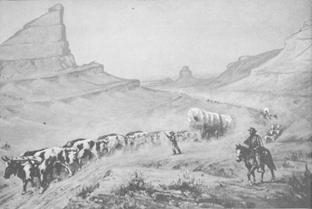
William H. Jackson painting of bull train in Mitchell Pass based on original sketch of 1866.
Standing near the fort’s gate, Uriah watched a wagon train slowly pass by on its way west. The emigrants looked nothing like the hopeful families who had set out from the settled states six weeks earlier. Every wagon was coated in a thick layer of prairie dust, the once-white canvas tops now stained the color of old parchment. The creaking of wagon wheels, the rattle of harness chains, and the lowing of tired oxen filled the air. Men walked beside their teams with sunburned faces and sweat-stained shirts, while weary women tended children who were barefoot, dusty, and browned by weeks under the prairie sun. The entire train carried the smell of the trail—dust, livestock, wood smoke, leather, and sweat. Uriah noticed that many wagons seemed lighter than they should have been. Somewhere along the hundreds of miles behind them, treasured furniture, trunks, tools, and other possessions had been abandoned beside the trail in exchange for easier travel. Yet despite their exhaustion, the emigrants kept moving westward. As wagon after wagon rolled past the fort, Uriah could see determination in their faces. They had already endured hardships that would send many men home, but they continued toward Fort Laramie, the mountains beyond, and whatever future awaited them on the far side of the frontier.
“Maybe I will head West, once I get out of this man’s Army”, he thought.
The commanding officer seldom took chances. An escort detail would be assigned to accompany the trains westward toward Fort Laramie. The soldiers would ride alongside the emigrants for several days, helping guard against theft, keeping watch over the surrounding country, and providing reassurance to nervous travelers.
Most escorts passed without incident.
The soldiers rode.
The wagons rolled.
The emigrants worried.
And everyone arrived safely.
Still, the possibility of trouble remained ever present. Reports drifted in from travelers, stage drivers, and scouts. A stolen horse here. A missing mule there. Distant sightings of mounted warriors on the ridges overlooking the trail. Most reports amounted to nothing, but they served as reminders that the frontier remained a place where a man could not afford to become careless.
One evening, as the sun sank behind Scotts Bluff and painted the sky in shades of gold and crimson, Uriah stood near the corral watching another wagon train disappear westward along the Platte with a small escort.
Hunter stepped beside him, pipe already clenched between his teeth.
“Think they’ll make it?” he asked.
“They usually do.”
Hunter nodded.
“Most folks don’t realize that. They hear stories back east and think every mile of this trail is a battlefield.”
He lit the pipe.
A moment later the familiar coughing began.
The sound had become as much a part of fort life as the wind.
“You sound like one of my dad’s fucking pigs, ”Uriah said. Worse than the pigs he thought.
Hunter just coughed, spit up blood and grinned.
Uriah began to notice something different about Hunter. He had thinned down some and his cheeks were sunken. He was always spitting blood. He didn’t seem to have a spring in his step like he used to, and that sharp sense of humor seemed to fade. Probably nothing……..still that cough was worrisome and just down right disgusting.
Beyond the walls, the Oregon Trail stretched westward into the fading light. Another wagon train was on its way to Fort Laramie. And tomorrow would probably look much like today—roll call, work details, blowing dust, and the endless prairie.
At least that was what everyone expected.
The frontier had a way of changing expectations without warning.
One event would soon set the entire frontier ablaze.
Approximately 750 Cheyenne and Arapaho people, led by chiefs including Black Kettle and White Antelope, were camped along Big Sandy Creek in southeastern Colorado. Many believed they were under the protection of the U.S. Army while peace negotiations continued near Fort Lyon.
Those hopes were shattered on when Colonel John Chivington led Colorado volunteer troops against the camp. The attack left an estimated 230 Cheyenne and Arapaho dead, most of them women, children, and the elderly. The tragedy became known as the Sand Creek Massacre.
The massacre destroyed any remaining trust between many Plains tribes and the Army. In the months that followed, large bands of Lakota, Cheyenne, and Arapaho moved northward across the plains, striking settlements, ranches, stage stations, and telegraph lines. Many warriors sought revenge for Sand Creek, and the frontier soon felt the consequences.
One of the first targets was the settlement of Julesburg, Colorado, which was attacked and burned. Soon afterward, warriors appeared along the route between the North and South Platte Rivers. The small station at Lodgepole Creek Nebraska Territory was overwhelmed and set ablaze.
Fortunately, the telegraph operator was away when the attack began. Returning to find the station burning, he quickly rode to Mud Springs and sent word alerting both Fort Mitchell and Fort Laramie.
By the following day, the warriors had reached Mud Springs Station. There, a small group of soldiers, civilians, and stockmen prepared to defend the isolated outpost behind its sod and timber walls. The stage was set for one of the most notable frontier battles in western Nebraska.
Orders were soon dispatched to Camp Mitchell.
Uriah and his friends paused for a breather from the disagreeable chore of shoveling horse manure out of the corral. It was filthy work, but at least they could do it at their own pace without a sergeant hovering over them. Every so often, Uriah would slyly scoop up a dried horse turd and toss it at the back of Hunter. Then he’d quickly turn away and busy himself with his shovel. Hunter would spin around, scowling and looking for the culprit, but he could never figure out where the missile had come from.
Then the bugle sounded.
Assembly.
Every man in the fort recognized the call.
Sergeant Cooper appeared moments later, striding across the parade ground. His face was red as a beet, and he looked as though he might explode at any moment.
“Move, you lazy bastards! Fall in! Now!”
The men scrambled to get in line.
Something was different.
Uriah had seen Cooper angry before, but this wasn’t anger. It was urgency. The sergeant’s voice carried an edge that made every man move a little faster.
Cooper planted himself in front of the company and drew a deep breath.
“Troop! Attention!”
The command cracked across the parade ground like a rifle shot.
Conversations ceased instantly. Men straightened their backs and hurried into line.
A moment later Captain Theodore Grude approached.
Sergeant Cooper snapped to attention and delivered a sharp salute. Grude returned it without breaking stride. Uriah noted that Cooper sucked in his gut, to look a bit more stout around the Captain. “It didn’t help much Uriah giggled to himself.”
Captain Grude was a West Point graduate and a veteran of the Civil War. Tall, broad-shouldered, and always composed, he possessed the quiet confidence of a man accustomed to command. Some of the soldiers claimed he spent too much time trying to impress his superiors, but Uriah saw something different. Grude was ambitious, certainly, but he was also competent, and on the frontier competence mattered.
“At ease, Sergeant.”
“Troop, at ease!”
The men relaxed slightly.
Grude looked slowly across the formation.
“Men.”
Uriah always liked the way the captain addressed them. Not boys. Not troopers. Men.
“A telegraph station has come under attack by hostile Indians. A relief column will depart within thirty minutes. We will ride hard and travel through the night. Bring three days’ rations, seventy-five rounds of ammunition, and sufficient feed for your horses.”
The captain paused.
“There have already been civilian casualties.”
The words settled heavily over the formation.
“We do not know the enemy’s strength. We do know that fellow soldiers and civilians require assistance. We intend to provide it.”
No one spoke.
“Sergeant Cooper will make the assignments. The remainder of the company will stay prepared to move on short notice.”
Grude glanced down the line one final time.
“That is all.”
“Yes, sir!”
Cooper saluted sharply. Grude returned the salute and strode toward headquarters.
The moment he was gone, Cooper turned back to the company.
“Listen up. The following men will prepare to ride.”
He unfolded a sheet of paper.
“Corporal Scott.”
“Here.”
“Private Smith.”
“Here.”
“Private Yates.”
“Here.”
“Private Hunter.”
“Here.”
“Private Porter.”
Uriah’s stomach tightened.
The list continued.
When Cooper finally finished, he folded the paper and shoved it into his pocket.
“Thirty minutes, soldiers. Saddle your horses, fill your canteens, and draw your ammunition and rations.”
His voice hardened.
“Now move your asses!”
No formal dismissal was necessary.
The formation broke apart instantly.
Men ran toward the barracks, the stables, and the supply room.
Uriah hurried with the rest, his mind racing.
Part of him felt excitement. This was what soldiers were supposed to do. This was the adventure he had imagined when he enlisted. He was finally going to see a real Indian…maybe several!
Another part of him felt something else.
Fear.
He had heard the stories.
Every soldier on the frontier had.
He knew about the disasters that had befallen isolated detachments. He knew what happened when soldiers were overwhelmed. Bodies stripped of weapons and clothing. Horses taken. The dead left scattered across the prairie. Bodies mutilated.
He swallowed hard.
“I reckon it don’t matter much if you’re already dead,” he muttered to himself.
The words sounded hollow even to his own ears.
For the first time since joining the Army, the possibility of battle no longer seemed like a distant story.
It felt real. He reached in his pocket to feel the letter from home. He wondered if this would be the last.


Leave a Reply