Again, this post is based on the paper by John D McDermott, “‘We had a terribly hard time letting them go”: The Battles of Mud Springs and Rush Creek, February 1865” Nebraska History 77 (1996): 78-88, 5/24/2011 Nebraska State Historical Society
Uriah heard the bugler sound the call for final assembly while sitting in the outhouse. It was the second time he had been there since the initial formation nearly thirty minutes earlier. He was nervous. Scared, if he was being honest with himself. The thought of riding into his first real fight had tied his stomach into knots.
“Damn it,” he muttered.
He couldn’t be late. Sergeant Cooper would skin him alive.
Looking around, he searched for something—anything—to use. The only thing he found was a single crumpled page from an old issue of Harper’s Weekly. It would have to do.
A moment later he burst from the outhouse and hurried toward the corral.
Fortunately, he had packed his gear earlier. His blanket roll, rations, ammunition, and canteen were already secured. Smokey stood quietly at the hitching rail as if he hadn’t a care in the world.
“Wish I could say the same,” Uriah muttered.
He swung into the saddle, gathered the reins, and urged the horse toward the parade ground.
The column was already forming. It was now 4:30 pm Saturday afternoon. A force of 120 soldiers out of Fort Laramie was also forming but they had about 125 miles to travel. The men from Fort Mitchell had to provide the initial relief.
The 36 troopers lined up in pairs, horses shifting impatiently beneath them. Captain Grude sat at the head of the formation mounted on a tall bay horse. Beside him was Corporal Scott, calm and expressionless as always.
The rest of the detail fell in behind them.
Near the gate, Sergeant Cooper and the remaining garrison stood in formation awaiting the arrival of the post commander. The men stood rigidly at attention.
A few moments later Captain J. S. Shuman emerged from headquarters.
Shuman was not an imposing man in stature. He was short and thick through the middle, with coal-black hair and a beard that reached nearly to his chest. Yet no one doubted who commanded the post. He carried himself with the confidence of a man accustomed to being obeyed.
“Troop! Attention!”
Cooper’s voice rang across the parade ground.
The soldiers straightened instantly.
Shuman walked to Captain Grude and exchanged a few quiet words that Uriah could not hear. Whatever was said was brief. Grude nodded, snapped a sharp salute, and Shuman returned it.
The moment felt strangely final.
Then Grude settled into his saddle and turned toward the gate.
“Forward, troop!”
The column lurched into motion.
Hooves clattered against the hard-packed ground as the troopers rode through the gate and out onto the open prairie. Uriah glanced back and saw the men remaining behind at the fort growing smaller in the distance.
Ahead lay Mud Springs, 50 miles in the distance. This would be an all-night ride.
Ahead lay danger. And for the first time since joining the Army, Uriah was riding toward a battle instead of merely hearing stories about one.
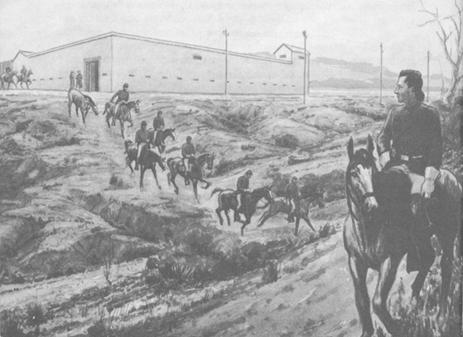
Cavalrymen leaving Fort Mitchell. Original sketch in Oregon Trail Museum.
The troop rode at a steady pace, fast enough to make good time but not so fast as to exhaust the horses. Out on the prairie, water was scarce and the summer heat unforgiving. Captain Grude knew that a worn-out horse was worse than no horse at all. If trouble lay ahead, the men would need fresh mounts beneath them.
Uriah kept his eyes fixed on the trail ahead for the first few hours of the ride. Eventually, he glanced over his shoulder and studied the column behind him. He recognized nearly every man. Some were hardened veterans who had survived the Civil War. Others, like himself, were younger soldiers with little experience beyond the routine duties of frontier life. It was an odd mixture, but most could ride well and shoot straight, which gave Uriah some comfort.
The troop looked nothing like the neat cavalry formations pictured in Army manuals or today’s Hollywood movies. Most of the men had long since abandoned parts of their government-issued uniforms in favor of more practical clothing. Broad-brimmed hats replaced the regulation kepis, and lightweight cotton shirts were preferred over itchy wool coats whenever regulations could be ignored. The result was a colorful assortment of hats, shirts, scarves, and boots that made the column resemble a band of outlaws more than United States soldiers.
The kepis offered little protection from the relentless sun, and the heavy wool uniforms were miserable in the heat. Out on the plains, comfort often mattered more than appearance. The men were preparing for a hard ride and possibly a fight. They needed clothing that worked, not clothing that looked impressive on a parade ground. Captain Grude didn’t give a damn about appearance while out in the field. He needed men who could fight and who could be depended upon.
Hunter rode beside Uriah. Like the rest of the column, he had grown unusually quiet. His eyes moved constantly, scanning the prairie ahead, then the ridges to either side. Every draw, patch of brush, and distant hill seemed worthy of suspicion.
“I think we’ll be all right,” Hunter said at last. “We’ve got some damn good men with us.”
He reached into his shirt pocket, pulled out his pipe, and struck a match.
“Yup,” was all Uriah could think to say.
Hunter took a deep draw.
Almost immediately, the familiar coughing began.
At first it was a single cough. Then another. Within seconds he was hacking so hard that several riders turned in their saddles to look.
This time it caught Captain Grude’s attention.
The captain wheeled his horse around and trotted back through the column until he reached Hunter.
“Private Hunter.”
Hunter straightened in his saddle.
“Yes, sir.”
Grude pointed at the pipe.
“Private Hunter, if I see that pipe again before we reach Mud Springs, I’ll personally stick it up your ass. Are we clear?”
“Yes, sir.”
“We’re riding through hostile country. The smell of tobacco carries farther than you think, and your coughing can probably be heard halfway to Omaha.”
A few of the men grinned.
Even Hunter looked slightly embarrassed.
Grude rose in his stirrups and addressed the entire column.
“Listen up, men. Maintain silence while on the march. No smoking. Keep your eyes open and your mouths shut. If there are Indians out there, I don’t intend to help them find us.”
“Yes, sir,” several voices answered.
The captain nodded and rode back to the head of the column.
Hunter watched him go, then reluctantly slipped the pipe back into his pocket.
Uriah glanced over at him.
“That might be the first smart thing you’ve done all day.”
Hunter frowned.
“That pipe’s been with me since Virginia.”
“Then maybe it’s time you stopped trying to smoke it to death.”
For once, Hunter had no reply.
The troop followed the course of the Platte River, riding east at a steady pace. The river wound through the broad valley below, its shallow channels glinting in the sunlight. Cottonwood groves lined portions of the bank, offering occasional patches of shade in an otherwise unforgiving landscape.
After nearly four hours in the saddle, Captain Grude finally raised his hand.
“Halt.”
The command was greeted with quiet relief.
The column turned toward a stand of cottonwoods near the river, where the men could rest both themselves and their horses. Uriah was more grateful than he cared to admit. Every mile seemed to have rubbed him raw. Between the heat, the dust, the sweat, and his earlier lack of proper toilet paper, he was thoroughly miserable.
As soon as the troop halted, he swung stiffly from the saddle and nearly winced when his boots hit the ground.
“Damn,” he muttered.
Even Smokey seemed happy to stop.
Uriah loosened the reins and led the horse down a gentle slope toward the river. The water was shallow and clear, moving lazily around sandbars and patches of reeds. Smokey wasted no time, lowering his head and drinking deeply.
Uriah splashed a handful of cool water onto his face and neck. The relief was immediate. For the first time all day, he felt something other than dust and sweat.
Around him, the other soldiers tended to their mounts. Some watered horses while others sat beneath the cottonwoods, grateful for the shade. A few removed their hats and let the breeze cool their faces. Even Captain Grude appeared content to give both men and animals a brief respite.
The prairie was quiet except for the murmur of the river, the rustling of cottonwood leaves, and the occasional nickering of horses.
For a few precious minutes, the war, the Indians, and Mud Springs seemed very far away.
Private Hunter looked uneasy without his pipe. Every few minutes his hand drifted toward his shirt pocket to make sure it was still there. The gesture had become second nature, almost as automatic as breathing. More than anything, he wanted to pack the bowl, strike a match, and draw in the sweet tobacco smoke that had become his constant companion.
But Captain Grude’s warning still rang in his ears. He also spied Corporal Scott checking him from time to time.
So Hunter resisted.
That did not make things any easier.
Without the pipe, the cough remained. Every so often a tickle would rise in his throat, and Uriah could see him fighting to suppress it. Hunter would clench his jaw, swallow hard, and stare off toward the river, determined not to let a single cough escape. His eyes watered from the effort.
Uriah watched him for a moment and, surprisingly, felt a little sorry for the man.
His own backside felt like it had been rubbed raw by hours in the saddle. Between the heat, dust, sweat, and his unfortunate shortage of toilet paper earlier in the day, he was miserable enough.
But Hunter looked worse.
The Virginian sat beneath a cottonwood tree with his hat pulled low over his eyes, one hand resting on his pocket as if it contained a treasured family heirloom rather than a battered old pipe. He seemed restless, uncomfortable, and oddly incomplete without it.
Uriah shook his head. For the first time all day, he figured there was at least one man in the troop having a rougher ride than he was.
While the men rested in the shade of the cottonwoods, Captain Grude called Corporal Scott aside and quietly issued a few instructions. A moment later Scott selected two troopers and the three mounted up.
“Scout ahead a few miles and report back,” Grude ordered.
Scott nodded.
Without another word, the three men turned their horses eastward and rode away from the river.
Uriah watched them go.
They crossed a low bluff overlooking the Platte Valley, their silhouettes briefly outlined against the sky. Then they disappeared beyond the ridge.
The sight sent a chill through him.
One moment they were there. The next they were gone.
Just swallowed up by the prairie.
It reminded Uriah how easy it would be for a man to vanish out here. A rider could disappear behind a hill, into a draw, or among a stand of cottonwoods and never be seen again.
For the next several minutes he found himself staring in the direction they had gone.
Listening.
Waiting.
He half expected to hear the distant crack of rifle fire or the faint report of a carbine echoing across the valley. Anything that might reveal what lay ahead.
But nothing came.
The prairie remained stubbornly silent.
Only the murmur of quiet conversations drifted through the camp. Horses shifted their weight, occasionally nickering or stamping at flies. The river whispered past the sandbars, and a breeze rustled the cottonwood leaves overhead.
Otherwise, there was nothing.
No gunshots.
No shouting.
No warning.
Just silence.
For some reason, Uriah found that more unsettling than if he had heard a fight. The prairie seemed to be holding its breath, waiting for something.
And all they could do was wait with it.
Uriah continued scanning the eastern horizon, searching for some sign of the scouting party. Minutes passed slowly. Then, at last, he saw them.
At first they were nothing more than three tiny specks against the prairie. Gradually the dots grew larger until he could make out riders and horses.
“Thank God,” he thought.
The words surprised him.
Raised in a devout Methodist family, he had spent most of his early life attending church and listening to sermons. Yet since joining the Army, thoughts of God had become infrequent. Out here, daily life seemed to revolve around horses, dust, fatigue, and hard work. But now, riding toward an uncertain fate, he found himself seeking comfort in religion once again.
Corporal Scott and the two scouts rode directly to Captain Grude. The four men spoke quietly for several minutes. Uriah couldn’t hear a word, but their serious expressions suggested the news was important.
The discussion ended with sharp salutes.
A moment later Scott turned in his saddle.
“Mount up!”
The brief rest was over.
Groans and muttered complaints drifted through the cottonwoods as the men climbed back into their saddles. Uriah swung onto Smokey and immediately felt the soreness return.
“Going to be a damn long night,” he thought.
The troop moved out once more, following the Platte eastward. Darkness gradually settled over the valley, bringing welcome relief from the day’s heat. A cool breeze swept across the prairie, rustling the cottonwoods and carrying the scent of the river.
The miles slipped by.
Uriah eventually lost track of time. He guessed it was near midnight, perhaps later. Above them stretched a cloudless sky crowded with stars. The moon hung bright over the plains, casting enough light to follow the trail without difficulty.
Sometime during the night he spotted the familiar silhouette of Courthouse Rock rising from the darkness like a giant fortress. Its pale cliffs glowed in the moonlight, standing watch over the valley just as they had for countless travelers before them.
Near the landmark, Captain Grude led the column south.
The steady rhythm of the ride began to take its toll. Men nodded in their saddles. Horses plodded forward with practiced confidence. The gentle rocking motion made it difficult to stay awake.
Uriah fought to keep his eyes open.
His body ached. His eyelids felt heavy. More than anything, he longed for the hard bunk back at Fort Mitchell.
Strange, he thought.
A few days earlier he would have gladly traded that bunk for adventure.
Now he would have traded a month’s pay just to lie down on it for a few hours.
The troop halted once more a mile west of Mud Springs. Captain Grude called Corporal Scott forward and quietly dispatched him and two scouts ahead to assess the situation.
The rest of the men waited in tense silence.
It did not take long.
Scott soon reappeared over a rise and rode hard back toward the column. His horse was lathered with sweat, and the corporal wasted no time in reporting to Grude. The two men spoke briefly.
Whatever Scott had seen was enough.
Grude turned to the bugler.
“Sound the call.”
The bugle shattered the morning silence, its notes carrying across the valley. The signal was intended for the defenders trapped inside Mud Springs Station. Help had arrived.
The first rays of sunlight were beginning to creep over the eastern horizon. The men had been in the saddle all night, and the long ride showed on every face.
Moments later the troop rode into Mud Springs.
Uriah stared at the place in disbelief.
The station was little more than a corral, a stable, and a small sod-and-timber building that housed the telegraph office and living quarters. It seemed impossibly small to be the center of so much trouble.
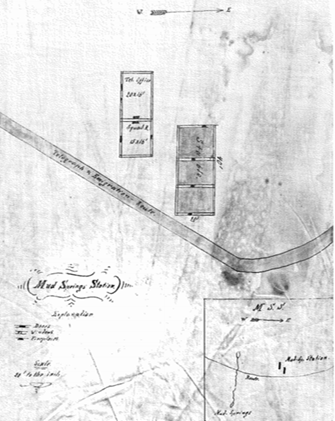
Actual Drawing of the ground plan of Mud Springs,
Colorado State University
The defenders, however, were delighted to see them.
Nine soldiers, a telegraph operator, and four stockmen emerged from their positions looking exhausted but relieved. They had managed to hold out thanks largely to their repeating Spencer carbines, which gave them a tremendous advantage in firepower.
Captain Grude took one look around and immediately saw the problem.
The station sat in a bowl surrounded by bluffs, gullies, and low ridges. Enemy warriors could approach from nearly any direction while remaining concealed. It was a terrible defensive position.
There was no time for celebration.
“Establish a defensive perimeter!” Grude shouted.
The men went to work immediately.
“Corporal Scott!”
“Sir!”
“Get your hands on anything you can find and build barricades around this station. Pay particular attention to the corral. The last thing those hostiles need is a chance to steal our horses.”
“Yes, sir.”
Within minutes soldiers were dragging wagons, barrels, crates, boards, buckets, and anything else they could find into makeshift defensive positions.
The work progressed quickly at first.
Then came the first shot.
Crack!
A bullet whined overhead.
Every man froze.
Another shot followed.
Then another.
The warriors remained hidden among the bluffs, taking long-range shots whenever a soldier exposed himself.
Soon the firing increased.
Bullets snapped through the air. Dust kicked up around the workers. Men instinctively crouched lower behind whatever cover they could find.
The enemy was creeping closer.
Grude studied the surrounding terrain and made a decision.
“Corporal Scott!”
Scott appeared instantly.
“Take sixteen men and occupy the bluffs behind the station. Sweep the gullies and drive the enemy back. I want those heights secured. Hold them until further orders.”
“Yes, sir.”
“If the position becomes untenable, fall back to the station.”
“Understood, sir.”
Grude looked toward the ridges.
“A relief column from Fort Laramie should arrive sometime today. Until then, I don’t intend to sit down here and let them pick us apart.”
Scott nodded.
“Yes, sir.”
The corporal stepped outside and immediately began calling names.
“Bauer! O’Brien! Murphy! Doyle! Hatcher! Porter!……..”
The names rolled from his tongue without hesitation, almost as though he had anticipated the captain’s orders.
“Listen up!” Scott shouted. “The following men will prepare to move immediately. Bring water, light rations, and one hundred rounds of ammunition. Mount up and report here at once.”
More names followed, but Uriah barely heard them.
His mind had stopped at Porter.
For a moment the sounds around him seemed distant.
The crack of rifles.
The shouted orders.
The movement of men scrambling for equipment.
None of it mattered.
He had wanted adventure.
He had wanted to see action.
Now he had been chosen.
Uriah swallowed hard.
The reality of combat had finally arrived.
Now it felt different.
Now there was a knot in his stomach.
The bullets snapping overhead were real. The enemy hidden among the bluffs was real. Men could be wounded. Men could be killed. And there was a very good chance that before the day was over, he would be shooting at another human being who was trying just as hard to kill him.
Suddenly the stories told by Hunter and the other veterans made more sense.
None of them ever spoke about glory.
They talked about fear.
They talked about confusion.
They talked about dead horses, empty canteens, and the sick feeling that settled in a man’s gut before a fight.
Uriah looked around at the soldiers gathering ammunition and checking their weapons. Most appeared calm, but he now realized it was not because they were fearless. They had simply learned how to hide their fear.
His eyes found Corporal Scott.
The veteran was moving among the men with his usual steady confidence, checking equipment and issuing instructions. He looked as calm as a man preparing for morning roll call.
Uriah wondered if Scott had felt this way during his first battle.
Probably.
Every soldier had a first battle.
This one was his.
He took a deep breath, adjusted the Spencer carbine hanging from his shoulder, and walked toward his horse. The fear was still there, but so was something else.
Determination.
Whatever waited on those bluffs, he would face it alongside the men of his troop.
There was no turning back now.


Leave a Reply